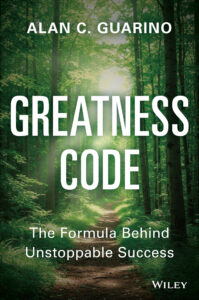
Greatness Code: The Formula Behind Unstoppable Success
In an exclusive interview Alan Guarino, vice chairman of Korn Ferry, talks with Richard Torrenznao about his soon-to-be-launched book, Greatness Code: The Formula Behind Unstoppable Success
Alan is a founding member of Korn Ferry‘s CEO Succession Practice and launched the Execution Accelerator initiative. He leads consulting across many industries in senior executive search and C-suite succession for Fortune 500 companies and high-growth firms.
A graduate of the United States Military Academy at West Point, Alan earned his MBA from Embry-Riddle University while serving on active duty.
In this conversation, Alan contrasts the notion of greatness in Appalachia with that in the financial world, emphasizing that, in under-resourced communities, greatness is measured by faith, family and community, rather than wealth or power. He stresses that greatness is personal and shaped by individual values.
He identifies five essential qualities for success – stamina, courage, resilience, persistence, and passion – along with social capital, the networks that support and promote you.
Rich: Success often seems tied to elite institutions or big titles. What changed in your view of greatness after working with under-resourced communities like those in Appalachia?
Alan: What I learned from the contrast in working with people in Appalachia versus working in financial markets around the world is that greatness is self-defined, and in business it’s very often about commercial accomplishment, financial accomplishment and power. But for many people those metrics are not what they care about.
In Appalachia, for example, the idea of financial wealth being a key driver is not really prevalent. Their greatness is measured in faith, family, community, food and shelter; those types of things.
It’s to know that greatness and personal achievement is very much just that … it’s a personal thing that must resonate with each individual.
Rich: So not everyone is chasing the same kind of finish line?
Alan: Well, every person is pursuing greatness objectives of some sort; but not always money and power. Individuals have multiple greatness objectives happening in their lives at any given time.
You might want to be a great community member, great parent, great friend or a great business executive … and all of those are workstreams that are all different, but they still require the key qualities that it takes to achieve anything. It requires the “Greatness Code “formula.
Rich: The book offers a framework for greatness and big goals, but what should leaders take from the book to help others grow or learn through change?
Alan: When you read the dedication, you’ll see that I wrote this book because I was so discouraged in seeing poor leadership become so prevalent, and great people having their careers stifled because the leadership environment wasn’t one  that fostered growth and opportunity.
I felt like we need to continue to try to build great leaders. But in the meantime, I want to empower people to get past situations where the leadership environment may not be so positive.
There are five key qualities (5Q’s) – stamina, courage, resilience, persistence and passion – that will get you 70 percent of the way towards whatever your greatness objective is over a period of time.
The other component is social capital (SC). The five Q’s plus SC equal greatness.
Social capital is the people around you, above you, below you, in the ecosystem that provide you leverage, that provide you contacts, that set you straight, that mentor you and that promote you to others when you’re not in the room.
That group of people that we call your network, plus the five qualities will get you the full 100 percent of the way towards what you’re trying to achieve.
Rich: Would you take each of the five qualities and just provide a quick definition or a comment of each?
Alan: Stamina is obviously enough fuel in the tank to go the full journey. Stamina must be maintained over a period of years, because the book talks about early career, mid-career, peak career and then coming down the mountain after the peak in the career. Early stage in the career, you’re building these qualities. They are like muscles; you need to make them stronger.
Courage is doing things that you’re afraid to do. That goes to taking on risk and pushing past fear
Resilience is moving forward in the face of disappointment and, or failure … so not giving up when you have been knocked down.
Persistence is the sibling of resilience. That’s the dogged determination to find ways to navigate around corners and find ways to pivot as you’re moving ahead.
That stamina, that resilience, that persistence, are all key qualities that keep you on the path towards greatness.
Passion is the ultimate fuel in the tank. It’s the thing that makes you excited about where you’re headed. Typically, that comes from seeing purpose in what you’re doing.
That’s why purpose is so important to people. That’s why when people lose their way, become dissatisfied and lose their passion, it’s largely because they’re doing things that they’re not excited about because their purpose isn’t there.
Rich: You talked earlier about social capital as a key to success. Why don’t you expand on that a little bit? Is that more important in today’s management style than it was 5, 10, 15 years ago?
Alan: Social capital has always been the secret ingredient that made the difference between people achieving their full potential opportunities or not. While we believe that hard work speaks for itself, it doesn’t. While we like to believe that we work in meritocracies, we either don’t or they’re imperfect.
At the end of the day, other people who have influence in the organization that you’re part of, whether it’s a community organization. a family or in business, have a lot to do with how you advance and how other people perceive you.
Additionally, we all need sounding boards. We all need people to set us straight. We all need people who we can call when we’re down and out and who will lift us up.
There are so many ways that social capital is a critical component of achievement. It’s always been important. In the world of AI, emotional intelligence, and therefore the network that you derive from having high emotional intelligence, will be more important than it has ever been.
Rich: Some people are natural networkers. What’s a realistic way for introverted people to build social capital without feeling fake?
Alan: Great question; it’s a hard one because I can’t aspire to be a worldclass basketball player in the NBA if I’m four-foot-three. We’re all given various capabilities and gifts.
If you are, let’s say, less outgoing as an individual, and perhaps shyer, and less people-oriented, then going after connections and relationships is something that you’re going to have to do as work. But we all do things as work versus things that we just love to do as part of our investment in getting ahead.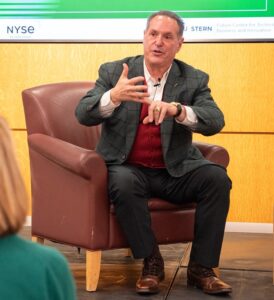
The first is that, whether you like it or not, you have to recognize that it is critical and you have to do it.
Then how do you do it authentically? Well, certainly most people have some friends and have some relationships. If you have some, then you have the aptitude to have a lot. It might be more work for you, but you have the aptitude.
One, you have to sort of embrace it and work on it. And you do have to be authentic. I say all the time that these relationships are two-way relationships. I don’t think there are very many people who don’t feel good when they give somebody something or they do somebody a favor. Maybe that’s how they should look at it.
Rich: Networking obviously changed under COVID and social media perhaps took off more than that. But today, for career advancement, what are the two or three things individuals should do to network to advance their career?
Alan: Analog is the new digital. My son taught me that. It was a smart observation. We are bombarded with so much digital content, and that includes people’s persona coming at us through Instagram or various other platforms like LinkedIn, in video form or in written form. That is just part of a lot of noise.
Yes, it definitely is part of the communication strategy but getting face-to -face with people, breaking bread, attending events and shared experiences is an exceptional way to make the connection stick even more than before, because it’s less of the norm.
When you get to spend physical time with people, it has a bigger impact. People should go out of their way to do that as opposed to defaulting to the Zoom or the Teams, easier digital opportunity.
Rich: Are there any other things besides the one-on-one meetings that make a lot of sense now?
Alan: You need to be an expert, because there’s so much content coming at us that people who find a way to be impressive actually connect with folks more readily.
People are triaging out so much noise that even if you meet with someone face-to-face, and after the meeting they say, “Gee, I really didn’t get much out of that,” they’ll be less interested in meeting with you again. While it’s face-to-face, you also have to have content. You have to find ways to be impressive.
Rich: Let’s go back to social capital for a minute. Is there a point where it’s too late, too hard to start, or is it just a constant thing that you have to do?
Alan: Well, if you don’t start, you’ll have limited opportunity. But if you decide you’ve missed the boat, you’ve guaranteed that you’ll suboptimize.
If you haven’t started and you’re mid-career, then start now because you’d like to get further along towards your greatness objective at the peak. If you’re halfway there, you’ve still got another half to go. So, it’s not too late.
Even in your peak career, you’re going to have a decade or two or more after you’ve peaked to go on and do what I call your second life. That second life requires the five Qs and social capital.
There’s never a time when it’s okay not to recognize the importance of the network, if you’re trying to get up every day, and live with some element of achievement and purpose.
Rich: You’ve seen and studied thousands of careers. What are the one or two patterns that show up in people whose careers take off compared to those that quietly stall?
Alan: Careers that stall are almost always stalled by the individual not taking responsibility for things that don’t go their way. When things go wrong, if those people are quick to blame others before they do the personal inventory, and figure out how they were part of the failure, then ultimately, they’ll peak at a level that’s below their aspirations.
Self-awareness is probably the number one attribute to drive success. If you’ve got all the qualities I’m describing, but you’re not self-aware, it’s like paddling a boat with holes in it. You’re paddling like hell with those qualities. But you’re in a leaky vessel to begin with. It’s never going to be perfect.
Rich: In the book you used the word “Coming down the mountain.” What does that moment represent in a person’s career? How does someone prepare for that?
Alan: That moment to me is the second life. It should be a time where you can either celebrate your achievement at the peak. You got to the top of the pinnacle. Or if you didn’t get as far as you had hoped to, you have to find a way to be okay with it and move ahead.
You can’t allow the lack of ultimate achievement wear you out every day and bring you down.
You need to get on with it, be satisfied with what you did because you gave it your best because you can’t change it anyway. Then move on to this next phase, which is a second opportunity to achieve that greatness objective in this latter part of your life.
Rich: In preparing for this interview, I spoke to several CEOs who disagreed with the idea of ‘coming down the mountain.’
They believe that even after reaching a high point in your career, you should stay relevant and continue to engage with your work, even if your role changes. Do you agree with this perspective?
Alan: Actually, I disagree, only because they’re not connecting with the metaphor.
 When you climb a mountain, like we talk about in the book, I use the Matterhorn Metaphor. It is a metaphor for a career journey; reaching the peak is only half the journey. You’ve successfully summited the
Matterhorn but you still have to return to the base camp to complete the journey. You have to come down the mountain.
What we talk about is that second life, which is what Arthur Brooks talks about in Strength to Strength. What’s deep in the epilogue of my book, which I did with Arthur. In Strength to Strength, he explains that there are neurological changes to the human brain that wire us later in life as we’ve peaked to find purpose in different things than we found originally.
As you climb the mountain towards the peak, you’re striving and driving, and you’re fueled by dopamine. Once you’ve hit that peak, you’re coming down that mountain to the base camp where you’ll finally get your ultimate rest and satisfaction; you’re helping others learn from you.
Rich: What is mentoring and what is the best way to mentor people? Should all leaders be a mentor?
Alan: Mentoring is being a resource for a smart person who knows the value of having a mentor so that they can optimize their own performance.
Being a mentor is very much like being a coach. Maybe it’s the same as being a coach. At the end of the day, that mentor relationship is a resource for somebody else provided by you in whatever form you’re comfortable with, and they’re comfortable with.
You could be a highly active person almost giving them the answers. I would say that that’s not the best because you want them to arrive at the answers through your guidance, but they don’t learn much if you give them the answer.
I don’t think you’re necessarily a mentor by example. Setting a proper example is definitely one thing. But mentorship, I think, requires active engagement in ways that both parties are benefiting and comfortable.
Rich: Alan, I just met you on an elevator, I haven’t seen you in 20 years and you said you just wrote a new book. In 15 seconds, what’s the most important thing about your book, and why should I read it?
Alan: Every person should understand they have an amazing opportunity to achieve, and that the formula to achieve is not complicated. If they learn that formula and they live what that formula prescribes, they’ll be very satisfied with where they end up. Whether that’s in personal goals or whether that’s in their career.
##